
ADAS Calibration in Underwood, Cameras and Radar Aimed the Way Your Car Was Built
ADAS scan and health check $99, single system calibration from $350, camera and radar together from $550, as at 2026. Done after a windscreen replacement, a wheel alignment, suspension work or a bumper repair, on a level bay with the targets your make specifies, two minutes off the Pacific Motorway.
What is ADAS calibration and why would my car need it?
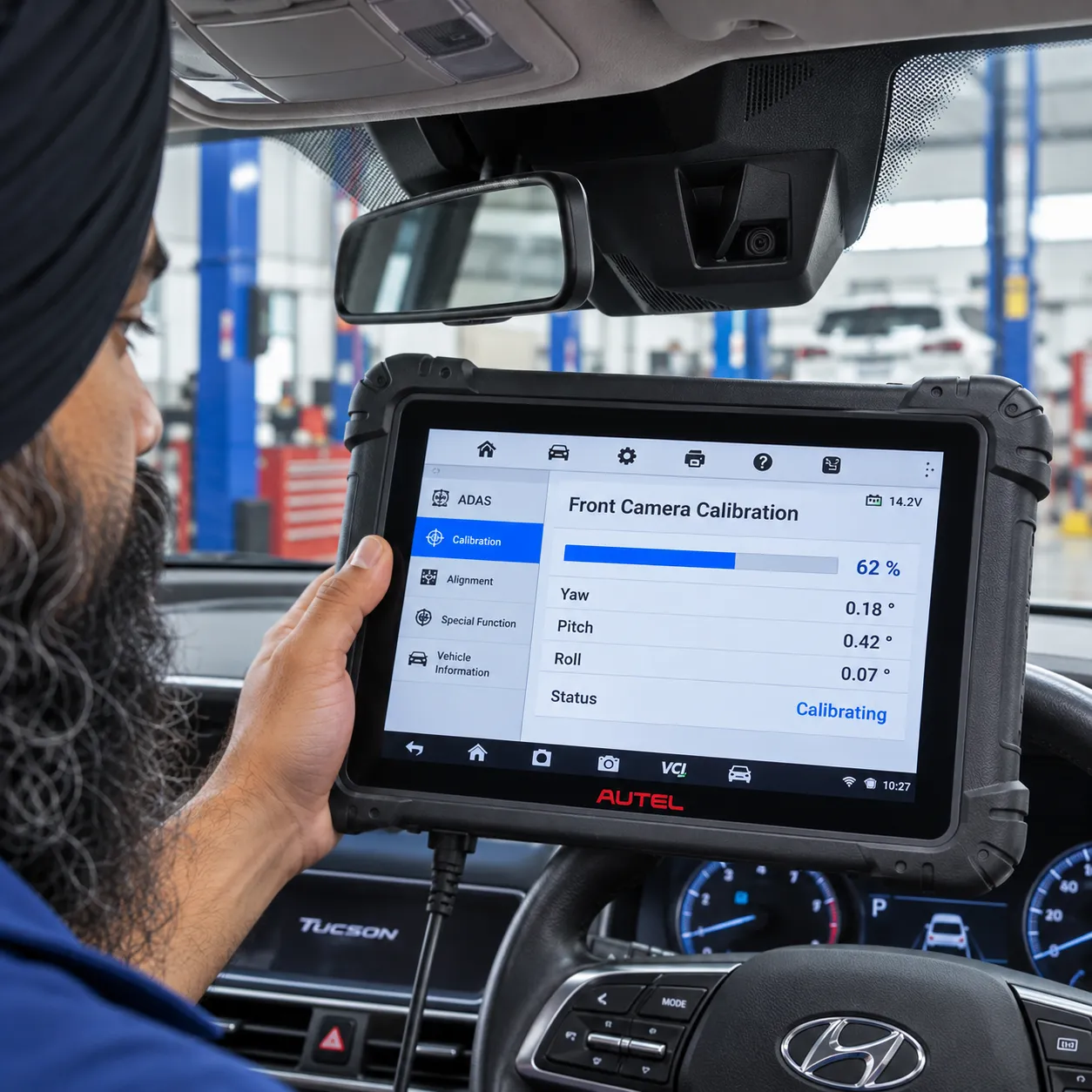
ADAS calibration is the job of aiming the camera behind your windscreen and the radar behind your grille so that they look exactly where the manufacturer designed them to look, then telling the car’s computer that they do. The letters stand for Advanced Driver Assistance Systems: autonomous emergency braking, lane keeping, adaptive cruise control, blind spot monitoring and the rest. Every one of them makes decisions from what those sensors see, and a camera that sits half a degree off sees a lane that is a car width out by the time it reaches the car in front.
Singh Mechanic Workshop and Tyre (you may know us as Singh Mobile Mechanic, Singh Auto Repair or Singh Mechanical) does ADAS calibration at the Underwood workshop at 6 Darnick Street, because calibration needs a level floor, a long clear bay and the wheel alignment hoist in the same building, and Underwood has all three. You can drop the car at Beenleigh and we move it.
You need calibration whenever something has moved the sensors or changed the way the car sits: a new windscreen, a wheel alignment, new springs or shock absorbers, a bumper repair, a sensor replaced, or a warning on the dash that a safety system is unavailable. The rest of this page explains each of those, what the job costs in Australia right now, what pushes the price up, and how to tell whether your car has been calibrated or just had the light cleared.
Is autonomous emergency braking compulsory on my car?
If your car, ute or SUV was a new model from 1 March 2023 or any new vehicle sold from 1 March 2025, yes. Australian Design Rule 98/00 (Advanced Emergency Braking for Passenger Vehicles and Light Goods Vehicles) applies to category MA, MB, MC and NA vehicles, which is every passenger car, off road passenger vehicle and light goods vehicle up to 3.5 tonnes, from 1 March 2023 for all new model vehicles and 1 March 2025 for all vehicles. ADR 98/01 adds pedestrian detection from 1 August 2024 for new models and 1 August 2026 for all vehicles.
That matters for one reason. The emergency braking on a 2025 HiLux, Ranger, RAV4 or Tucson is not a feature the dealer added, it is equipment the car was required to have, and the camera and radar that run it were aimed on a factory jig to a tolerance of a fraction of a degree. Anything that moves them afterwards leaves you with a system that is fitted, lit on the dash, and looking at the wrong piece of road.
| What the rule says, as at 2026 | Date | Who it covers |
|---|---|---|
| ADR 98/00, car to car emergency braking, new models | 1 March 2023 | Passenger cars, SUVs, utes and vans to 3.5 tonnes |
| ADR 98/00, car to car emergency braking, all new vehicles | 1 March 2025 | Same categories |
| ADR 98/01, adds pedestrian detection, new models | 1 August 2024 | Same categories |
| ADR 98/01, adds pedestrian detection, all new vehicles | 1 August 2026 | Same categories |
Source: Vehicle Standards (Australian Design Rules 98/00 and 98/01) 2021, clauses 3.1.1 and 3.1.2, legislation.gov.au. Older cars with the systems fitted as options are covered by the same calibration logic, the rule simply did not require them.
When does a car need ADAS calibration?
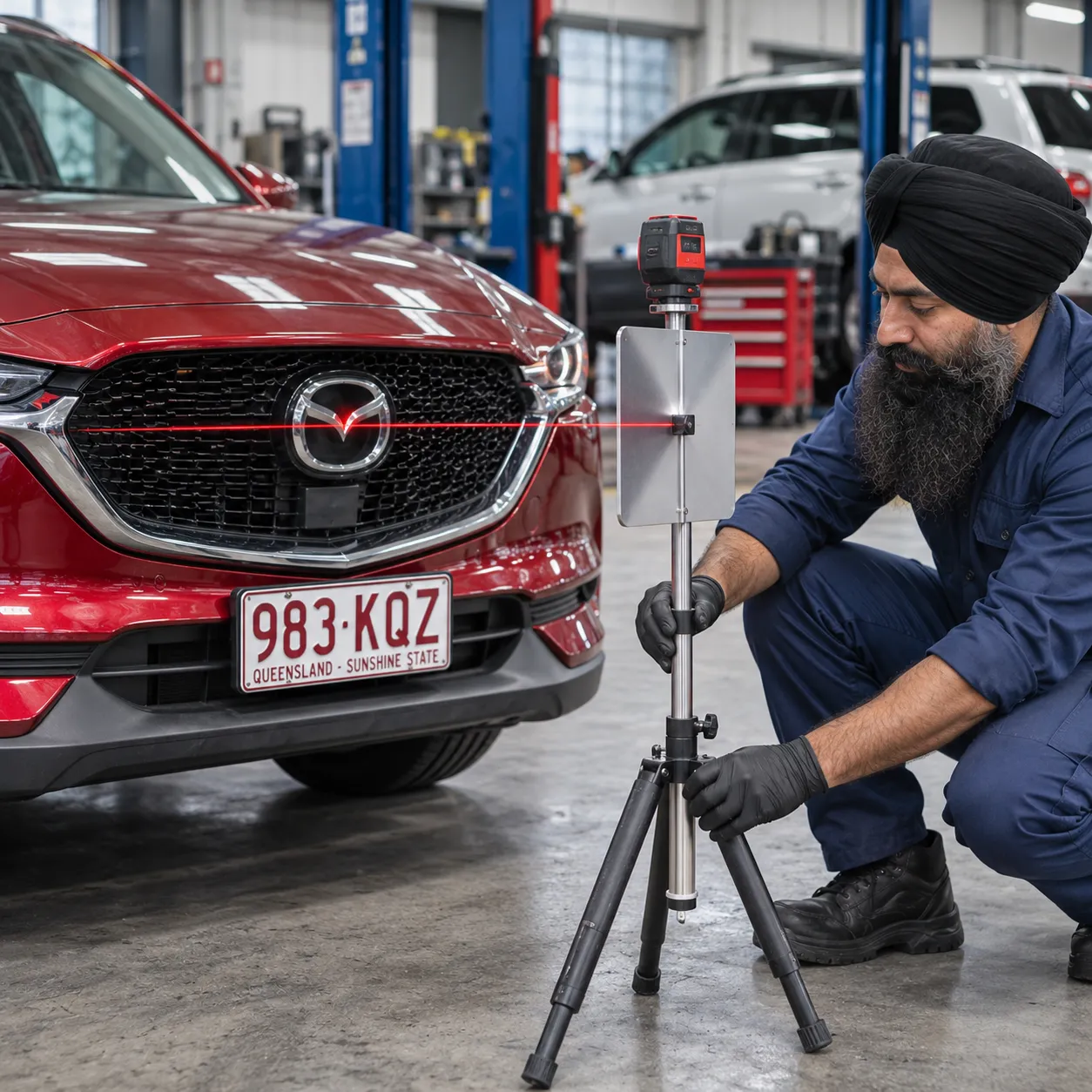
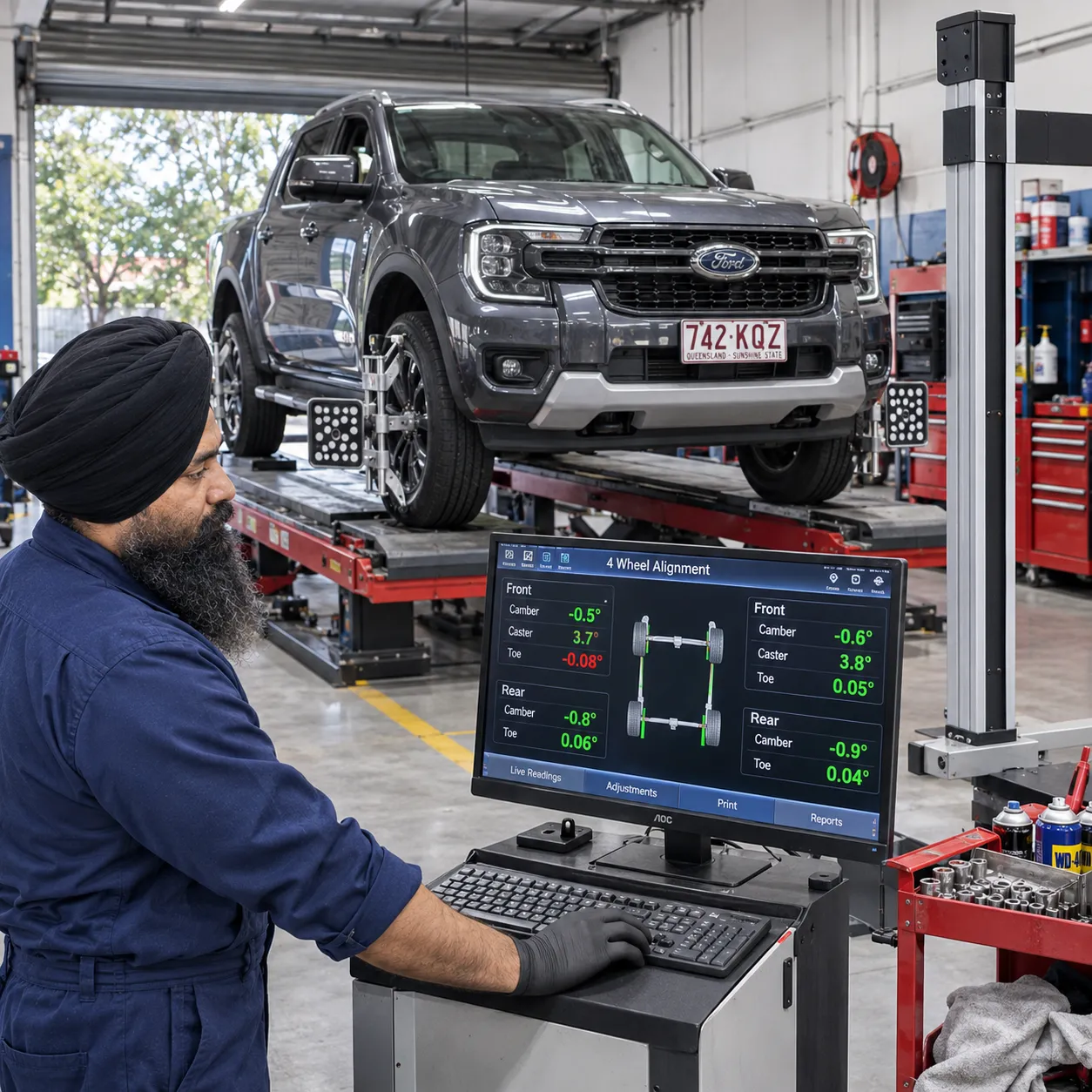
Any time the sensors have moved, or the car has. The six triggers below cover nearly every booking we see, and the one most drivers miss is the second: a wheel alignment. The camera is aimed along the line the car actually drives, not the line the body points, and an alignment changes that line. That is why an alignment on a car with lane keeping should end with a calibration, and why it is done on the same hoist here.
| What happened | Which sensors it affects | What the car may do without calibration |
|---|---|---|
| Windscreen replaced | Front camera behind the mirror | Lane keeping drifts or switches off, emergency braking reads distance wrong, camera blocked message |
| Wheel alignment or steering repair | Camera and radar, because the thrust angle the car drives along has changed | Lane centring pulls to one side, adaptive cruise follows the wrong lane |
| Springs, shock absorbers, lift or lowering | Radar and camera height and pitch | Radar sees the road or the sky, emergency braking triggers late or not at all |
| Bumper repair or replacement | Front and rear radar, parking and blind spot sensors behind the bumper skin | Blind spot monitor silent, cross traffic alert wrong |
| Camera, radar or module replaced | That sensor | Fault code stored, system unavailable until calibrated |
| Minor front end impact, kerb strike, new tyres of a different size | Everything, through ride height and geometry | Intermittent warnings, system switching off on the motorway |
How much does ADAS calibration cost in Australia, as at 2026?
Between $150 and $400 per system at an independent workshop, $500 to $1,000 at a dealer, and $400 to $900 for the European cars that need both a static and a dynamic procedure. Those are the published Australian figures as at 2026, and the spread comes down to three things: how many sensors the car has, whether the make needs targets in a workshop or a road drive or both, and whether anything else has to be fixed before the sensors can be aimed.
| ADAS service at Underwood | From price, as at 2026 | What it covers | Time |
|---|---|---|---|
| ADAS scan and health check | $99 | Full system scan, stored and pending fault codes, sensor status, ride height and tyre check, wheel alignment readout, written findings | About 1 hour |
| Front camera calibration, static | From $350 | Car levelled, targets set to the make's measurements, camera aimed and confirmed on the scan tool, before and after report | 1 to 2 hours |
| Front radar calibration | From $350 | Radar reflector set to specification, radar aimed and confirmed, report | 1 to 2 hours |
| Camera and radar together | From $550 | Both procedures in one visit with one report | 2 to 3 hours |
| Dynamic calibration, road procedure | From $250 | Scan tool drive cycle on the motorway at the speed and distance the make specifies, report | 1 to 2 hours |
| Calibration with wheel alignment | Alignment $99 plus calibration from $350 | Four wheel alignment to specification, then the calibration the new geometry needs | 2 to 3 hours |
| Calibration after a windscreen fitted elsewhere | From $350 | Camera bracket and glass checked, static or dynamic procedure as the make requires | 1 to 2 hours |
| Blind spot, rear radar or 360 camera | Quoted after the scan | Depends on the sensor and whether the bumper has to come off | Half day |
The $99 scan is included in every calibration, so you never pay for the scan and the job on top. Prices are from prices for passenger cars, utes and SUVs to 4.5 tonnes, as at 2026. European makes that need both procedures are quoted after the scan.
What makes an ADAS calibration expensive?
Damage that has to be repaired first, cars that need two procedures, and sensors that have to come out of a bumper. A straightforward camera calibration on a Toyota, Mazda or Hyundai is the from price. The bill climbs when:
- The car is not sitting right. Calibration is done to a level car with correct tyre pressures, no load and the right ride height. Worn springs, a lift kit or a boot full of tools has to be dealt with first.
- The alignment is out. A camera aimed to a car with the wrong thrust angle is aimed wrong. If the scan shows it, the alignment is done first, and the pricing table bundles the two.
- The make needs both procedures. Many European models, and some Subaru and Honda systems, need a static target session and then a road drive. That is the $400 to $900 band.
- A sensor is faulty, not just out of aim. A cracked radar, a camera with a damaged lens or a bracket bent in a bump has to be replaced before anything can be calibrated, and the part is quoted.
- The sensor lives inside the bumper. Rear radar and blind spot modules often mean the bumper skin comes off, which is labour the front camera never needs.
How do I keep calibration simple and cheap?
Book it with the job that caused it, keep the glass and the sensors clean, and do not let anyone clear the light without aiming the sensor.
- Calibrate on the same day as the alignment or suspension work. The car is already on the hoist, level, and measured. Two visits cost more than one.
- Tell your windscreen fitter the car has a camera. The bracket has to be bonded in the right place on the new glass; a badly placed bracket cannot be calibrated and the glass goes back.
- Keep the camera window clean. The patch of windscreen in front of the camera and the radar emblem on the grille are the two spots that get ignored at the car wash.
- Ask for the before and after report. A calibration that worked has numbers: the camera’s measured yaw, pitch and roll before and after, the radar’s measured angle, and the scan tool’s pass line. A light that simply went out has none.
- Do not fit a different tyre size without asking. It changes ride height and the car’s idea of its own speed, and both feed the camera.
What is the difference between static and dynamic calibration, and which does my car need?
Static calibration is done standing still in the workshop with printed targets and a radar reflector placed at measurements the manufacturer publishes, usually to the millimetre. Dynamic calibration is done on the road with the scan tool connected, driving at a set speed over a set distance so the camera can learn the lane markings and the radar can learn the car in front. Some cars need one, some need the other, and a growing number need both.
| Method | What happens | Which makes mostly use it | What it needs |
|---|---|---|---|
| Static | The car is levelled, targets are set at the make's distances and heights, and the scan tool aims the camera or radar against them | Toyota, Lexus, Mazda, Subaru, most Hyundai and Kia, many European makes | A level floor, a long clear bay, the correct target set, the wheel alignment hoist to centre the car |
| Dynamic | The scan tool starts a learn mode and the car is driven at a steady speed on clear lane markings until the system confirms | Ford, Holden era GM, some Honda, Nissan and Mitsubishi, many European makes as the second step | A motorway with clean lane lines, dry weather, daylight, the Pacific Motorway from Underwood |
| Both | Static first, then the road drive | Volkswagen group, BMW, Mercedes, some Subaru and Honda | Everything above, and the time for both |
The Underwood workshop is set up for the static side, which is the part most mobile operators cannot do properly on a sloping driveway, and the motorway on ramp is two minutes away for the dynamic side.
What do the ADAS warning messages on my dash mean?
They mean the system cannot see well enough to work, and the reason is almost always one of three: the sensor is blocked, the sensor has moved, or the sensor has failed. The wording changes by make, which is why owners search for the message and find nothing.
| What the dash says | Make | What it usually means |
|---|---|---|
| Pre Collision System malfunction, Lane Departure Alert unavailable | Toyota, Lexus | Camera aim or radar aim lost, often after a windscreen or alignment |
| Front camera blocked, clean camera | Toyota, Mazda, Subaru | Dirt, a sticker, a cracked windscreen in front of the camera, or a camera that has moved |
| Radar sensor blocked, clean sensor | Most makes | Mud or a bull bar over the radar, or a radar aimed at the road after suspension work |
| Pre Collision Assist not available, sensor blocked | Ford | Radar behind the grille badge blocked or out of aim |
| Smart City Brake Support unavailable | Mazda | Camera or radar aim, or windscreen glass not matched to the camera |
| EyeSight temporarily disabled | Subaru | Stereo camera pair out of aim, usually after glass or a bump |
| Forward Collision Avoidance Assist disabled, check camera | Hyundai, Kia | Camera aim after windscreen replacement |
| Blind Spot Collision Warning system fault | Hyundai, Kia, Mazda | Rear radar moved in a bumper repair |
My windscreen was replaced and the lane assist stopped working. Why?
Because the camera that runs it is bonded to the glass, and the new glass put it somewhere slightly different. The camera sits behind the mirror in a bracket that is glued to the windscreen at the factory, and a replacement screen carries a new bracket at a position that can vary by a few millimetres. A few millimetres at the mirror is metres at the horizon. That is why most makes require a calibration after any windscreen replacement, and why a screen fitted on the driveway without one leaves the car with a system that may brake late, or not at all.
We do not fit windscreens. What we do is calibrate the camera after any fitter has replaced the glass, check the bracket and the glass are the right type for the camera, and give you the before and after report. If your insurer paid for the glass, the calibration is usually covered as part of the same claim, and the report is what the insurer wants to see. Ask before you pay for it yourself.
Why does a wheel alignment change my ADAS calibration?
Because the car drives along its thrust line, not along its bonnet. The thrust line is set by the rear wheels, and the front camera and radar are aimed relative to it. A wheel alignment that corrects the rear toe moves that line, and the sensors are now aimed relative to a line that no longer exists. On a car without driver assistance nobody notices. On a car with lane centring, the car hugs one side of the lane and the driver fights it.
That is the reason calibration belongs in a mechanical workshop with an alignment hoist and not only at the glass shop. Suspension work, new springs, a lift or new tyres change ride height and pitch, and pitch is what points the radar at the road or the sky. The Underwood workshop measures the alignment first, corrects it if the scan says so, and calibrates to the car as it will actually be driven. Brakes are checked at the same time, because emergency braking is only as good as the brakes it commands.
Does calibration at an independent workshop affect my new car warranty?
No. The ACCC’s industry guide to the Australian Consumer Law for motor vehicle sales and repairs states that any suggestion a vehicle must be serviced at a licensed dealer to keep its consumer guarantee rights is not correct. A calibration done to the manufacturer’s procedure, with the make’s own target specifications and a printed before and after report, is exactly the record a warranty claim needs. Where a make reserves a procedure to its own tooling, which is rare but real on a few European models, we say so before you book rather than after.
Which makes and systems do you calibrate at Underwood?
Toyota Safety Sense on HiLux, RAV4, Corolla, Camry, Kluger and Prado, Mazda i Activsense on CX 5, CX 3, Mazda 3 and BT 50, Hyundai SmartSense and Kia Drive Wise, Subaru EyeSight, Ford Co Pilot360 on Ranger and Everest, Mitsubishi on Triton, Outlander and Pajero Sport, Nissan ProPILOT and Safety Shield, Honda Sensing, and the Volkswagen, Skoda, BMW, Mercedes and Audi systems that need both procedures. Hybrid and electric cars are calibrated here as well, on the same bay as our hybrid and EV servicing. If your make is not listed, call, because the answer is usually yes and it is given before you drive over.
Approved Inspection Station to 4.5 tonnes, so vans and light trucks with lane keeping fit on the bay.
Why drivers choose Singh at Underwood
The $99 scan finds what moved the sensor, so the calibration holds.
Geometry corrected first, then calibrated to the car as it drives.
The level floor for targets, and the motorway two minutes away for the drive.
Before and after angles and the pass line, every time, for you and your insurer.
On every repair, as at 2026, in writing.
Drop at Beenleigh or Underwood and we move the car between them.
The readings explained in the language that suits you.
Utes, vans and light trucks on the bay, safety certificates in house at Beenleigh.
What drivers say after the job
The mechanic quickly diagnosed the issue and fixed it efficiently without any hassle. Communication was clear the whole way through, and everything was explained in simple terms. Pricing was fair and transparent, with no surprises.
They use genuine parts and provide excellent service, including wheel alignments, tyres, and regular servicing with a proper logbook. I am very happy with their work and highly recommend them.
I had new tyres installed on my Haval H6 Hybrid, along with wheel alignment and tyre balancing from Singh Workshop everything was excellent. The service was top-notch and reasonably priced!
A light that goes out is not a calibration. A report with the angles on it is.
A camera and radar calibration after a bump is the job that gets put off. Split it with Buy Now, Pay Later and have the braking back this week.


ADAS calibration questions, answered straight
Do I really need calibration after a windscreen replacement, or is that upselling?
You need it on any car with a camera behind the mirror, which is every car built to the emergency braking rule and most from about 2018 on. The camera bracket moves with the glass, and the make’s own procedure calls for a calibration after replacement. If the fitter did not do one, or cannot show you a report, book the $99 scan and we will tell you in an hour whether the camera is within tolerance.
Can a wheel alignment really put my lane assist out?
Yes. The sensors are aimed along the line the rear wheels push the car, and an alignment that changes rear toe changes that line. Under lane centring the symptom is a car that sits to one side of the lane. A calibration after the alignment is the fix, and the pricing table bundles the two so it is done in one visit.
How long does ADAS calibration take?
One to two hours for a single camera or radar, two to three for both, plus the road drive for cars that need a dynamic procedure. Add the alignment if the scan shows the geometry is out. Most cars are back the same day, as at 2026.
Will my insurer pay for calibration after a windscreen claim?
Usually, because the calibration is part of returning the car to the condition it was in, and the make’s procedure requires it. Ask your insurer before you pay, and keep our before and after report, which is what they ask for.
Does a safety certificate check ADAS?
No. The Queensland light vehicle standards that a safety certificate inspects do not include driver assistance systems, so a car can pass with its lane assist switched off. That is exactly why it is worth having the calibration report, because nothing else on the car tells the next owner the system works.
Can calibration be done at home or on a mobile basis?
Static calibration needs a level floor measured to a few millimetres over several metres, controlled light, and the targets set to the make’s distances, which a driveway does not give. Dynamic procedures can be done on the road from anywhere, but most cars need the static step first. Both are done from 6 Darnick Street, and the motorway on ramp is two minutes away.
My car has no warning light. Could it still be out of calibration?
Yes. Small aim errors do not trigger a fault, they just move where the system looks. The signs are lane centring that favours one side, adaptive cruise that reacts late to the car ahead, or emergency braking that has never once intervened in traffic where it should have. The $99 scan reads the camera’s measured angles against the make’s tolerance and settles it.
Find the Underwood workshop
6 Darnick Street, Underwood QLD 4119, 0452 229 713, Monday to Saturday 8:00am to 5:30pm. Parking out the front. Directions.
Prefer Beenleigh? Drop at Unit 2/103 Harburg Drive and we move the car. Beenleigh directions.
Book the $99 ADAS scan at Underwood
You get the measured angles, the cause if something moved, and the calibration price in writing before anything is aimed. Call 0452 229 713, book your own slot online, or send the form and hear back within two business days, usually the same day.

Get Expert Repair & Service
We offer complete professional car care service for all your automotive needs.
- Mon to Sat: 8 am – 5.30 pm
- Sunday Closed
© Singh Mechanic Workshop and Tyre 2026. All Rights Reserved. Web by Digital Marketers Perth | Revised By Vindas Solutions